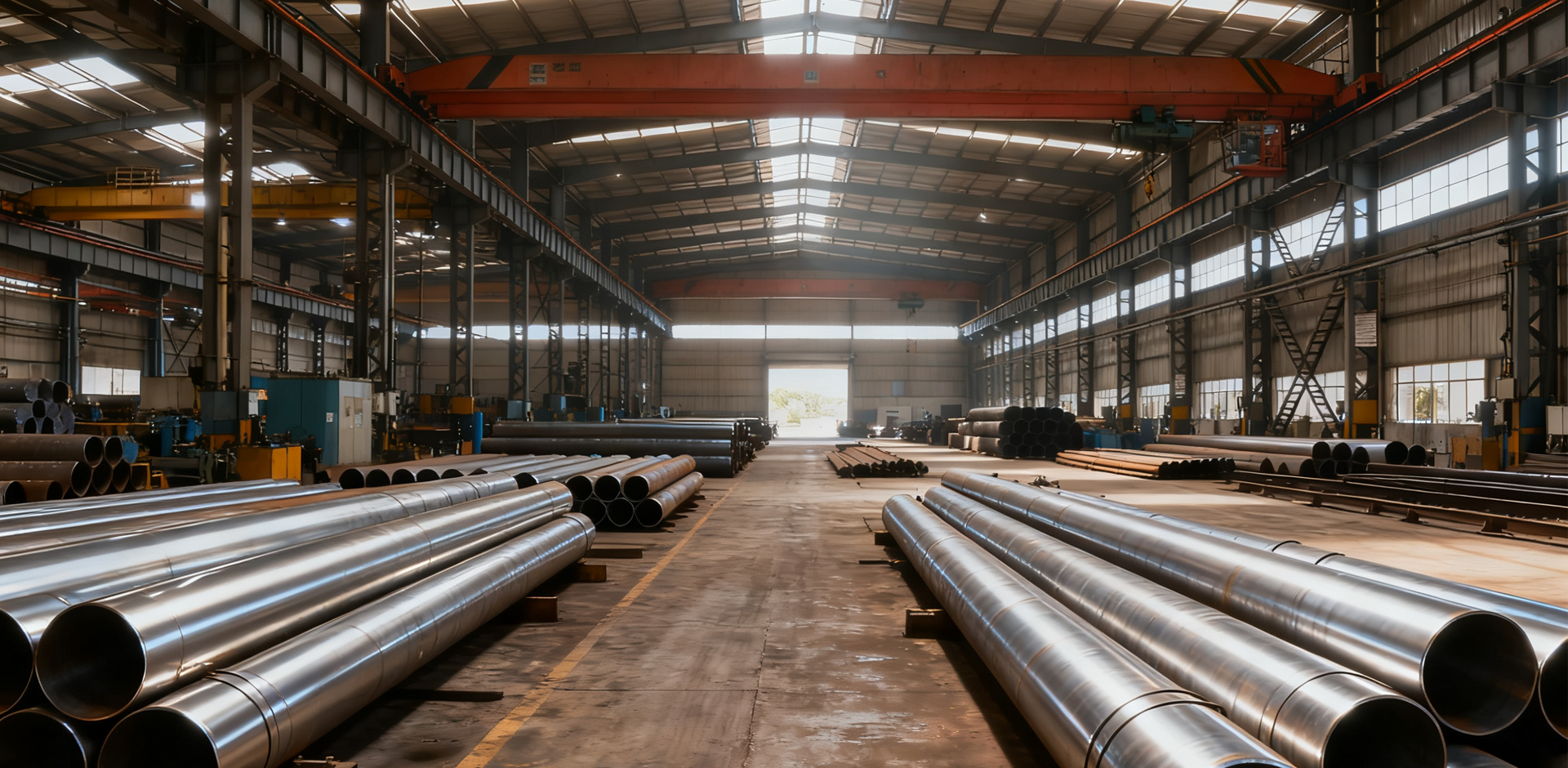
Carbon Steel Coils: A Practical Guide to Hot Rolled and Cold Rolled Steel
When purchasing steel materials, many buyers focus first on price, but experienced purchasers know that carbon steel coil selection involves much more than cost. Steel grade, production process, surface condition, dimensional tolerance, and supplier reliability all influence the final application performance.
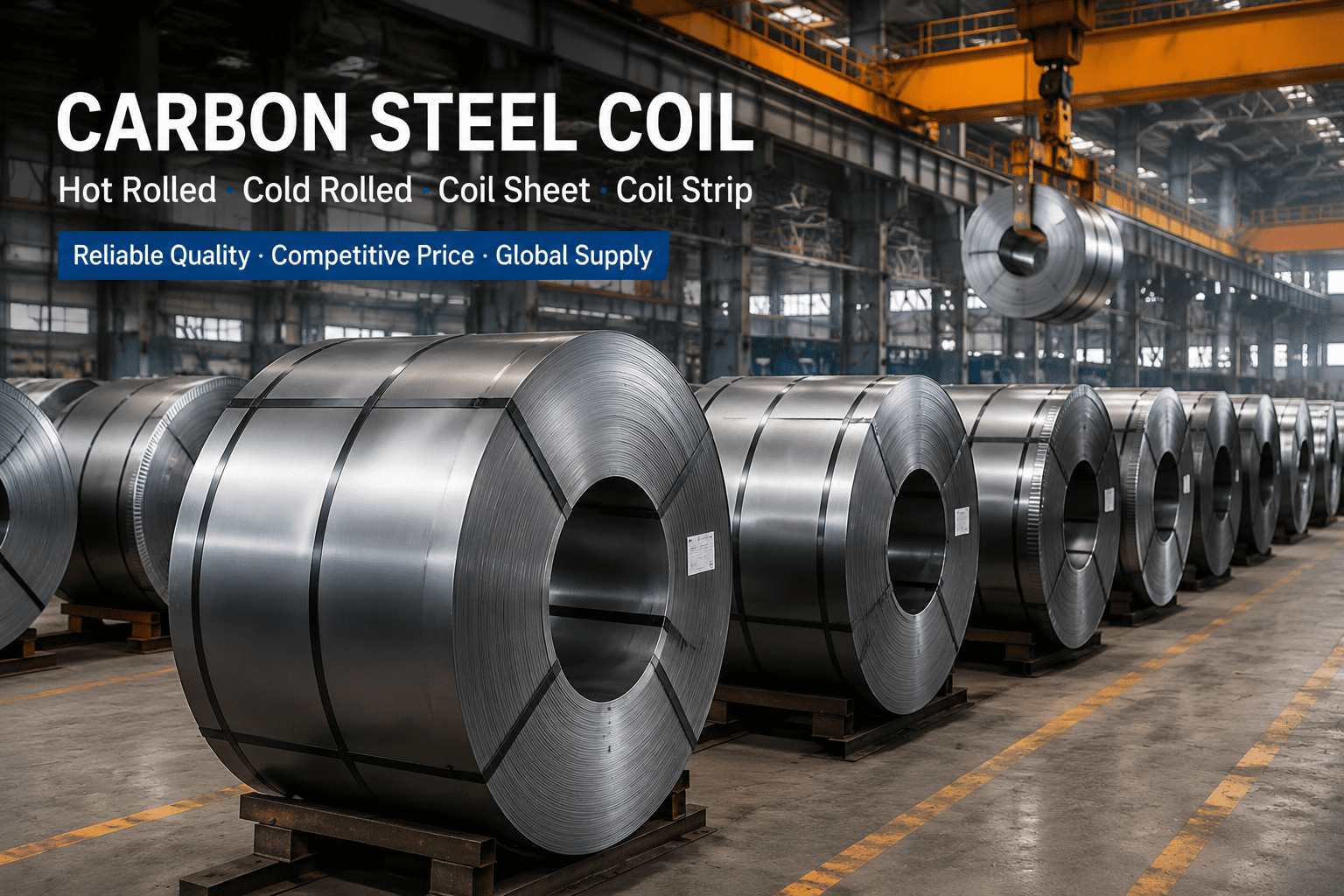
Carbon steel coil is one of the most common flat-rolled steel products supplied to industries such as construction, automotive manufacturing, machinery production, steel pipe fabrication, and metal processing. It is produced by rolling steel slabs into continuous coils, which allows manufacturers to store, transport, and process large quantities of steel efficiently.
For overseas buyers, understanding the differences between hot rolled carbon steel coil, cold rolled carbon steel coil, and processed products such as carbon steel coil sheet and carbon steel coil strip can help avoid material selection problems during production.
Understanding Carbon Steel Coil
Carbon steel coil refers to steel products supplied in a rolled coil form, with carbon as the main alloying element. The carbon content and manufacturing process determine the final mechanical properties, surface quality, and application range.
Unlike steel plates that are produced in fixed dimensions, coils are supplied in long continuous lengths. This makes them suitable for customers who use cutting, stamping, forming, or further rolling processes.
In actual steel procurement, buyers normally check several key factors before placing an order:
Steel grade and standard requirement
Thickness and width tolerance
Coil weight and inner diameter
Surface condition
Mechanical properties
Inspection documents
A small difference in thickness tolerance or surface quality can affect production efficiency, especially for manufacturers using automated processing lines.
Main Categories of Carbon Steel Coil
In the steel industry, carbon steel coils are mainly divided according to the rolling process rather than their final shape.
The two major product categories are:
Hot rolled carbon steel coil
Cold rolled carbon steel coil
Products such as carbon steel coil sheet and carbon steel coil strip are usually produced by additional processing from these basic coil materials.
Hot Rolled Carbon Steel Coil
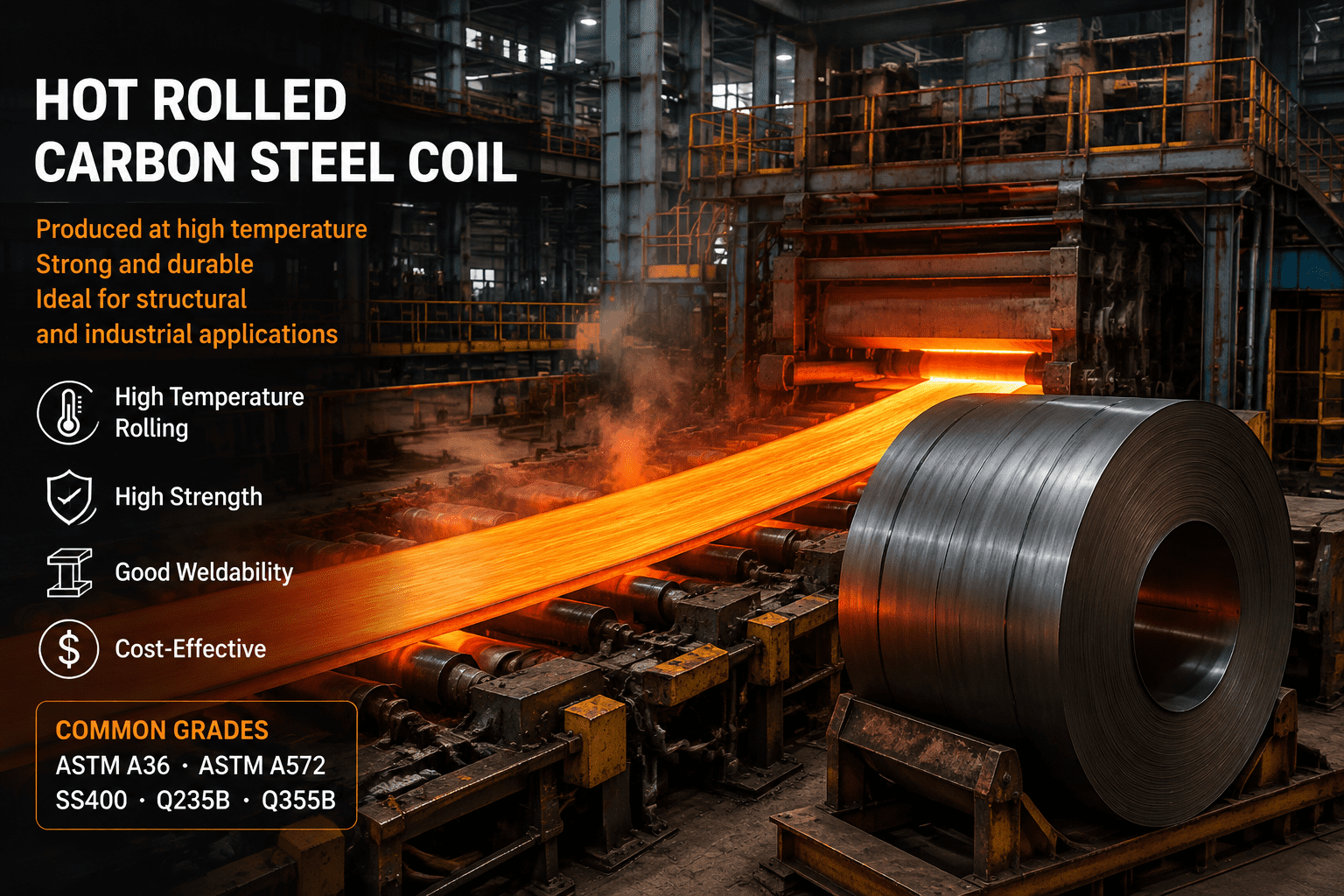
A hot rolled carbon steel coil is produced by heating steel slabs to a high temperature and passing them through rolling mills until the required thickness is achieved.
Because the steel is processed at elevated temperatures, hot rolling allows manufacturers to produce thicker coils with strong structural properties and relatively lower production costs.
Hot rolled coils normally have a dark surface caused by oxide scale formed during the rolling and cooling process. For applications where appearance is not the primary concern, this surface condition is usually acceptable.
Common grades include:
ASTM A36
ASTM A572
SS400
Q235B
Q355B
These materials are widely used for structural and industrial applications.
Typical uses include:
Building structures
Steel bridges
Heavy machinery components
Welded steel pipes
Shipbuilding materials
Storage tanks
From practical supply experience, many construction and engineering customers prefer hot rolled carbon steel coil because it provides a good balance between strength and material cost.
Cold Rolled Carbon Steel Coil
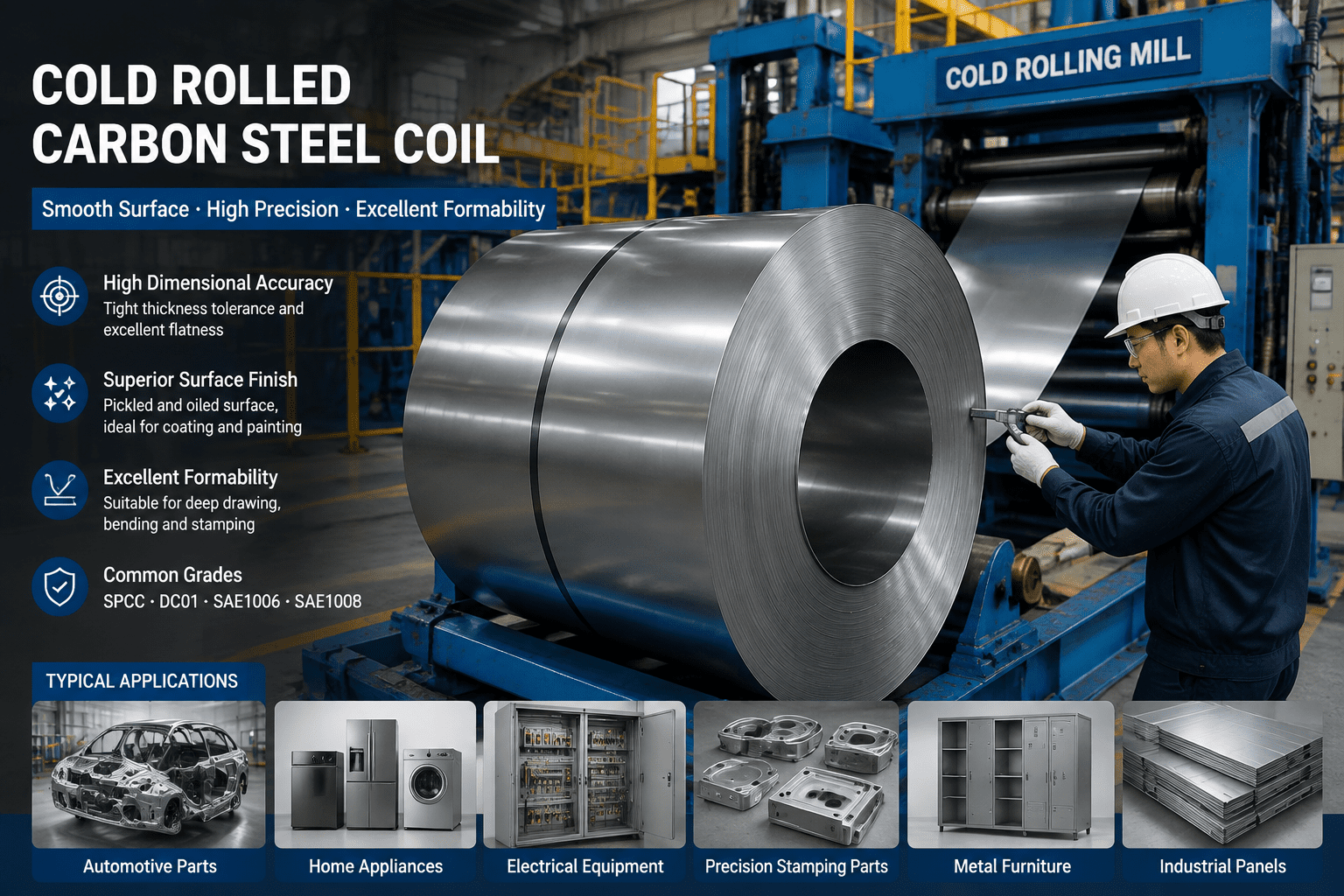
A cold rolled carbon steel coil is produced by further processing hot rolled coil at room temperature.
Before cold rolling, the steel surface is usually cleaned through pickling to remove oxide scale. The cold rolling process improves thickness accuracy, flatness, and surface finish.
Cold rolled coils are usually selected when the final product requires better appearance or tighter dimensional control.
Common grades include:
SPCC
DC01
SAE1006
SAE1008
Typical applications include:
Automotive body parts
Electrical equipment
Household appliances
Precision stamping parts
Metal furniture
Industrial panels
During actual purchasing, automotive and appliance manufacturers usually pay closer attention to surface defects and thickness deviation because these factors directly influence forming performance and product appearance.
Carbon Steel Coil Sheet and Carbon Steel Coil Strip
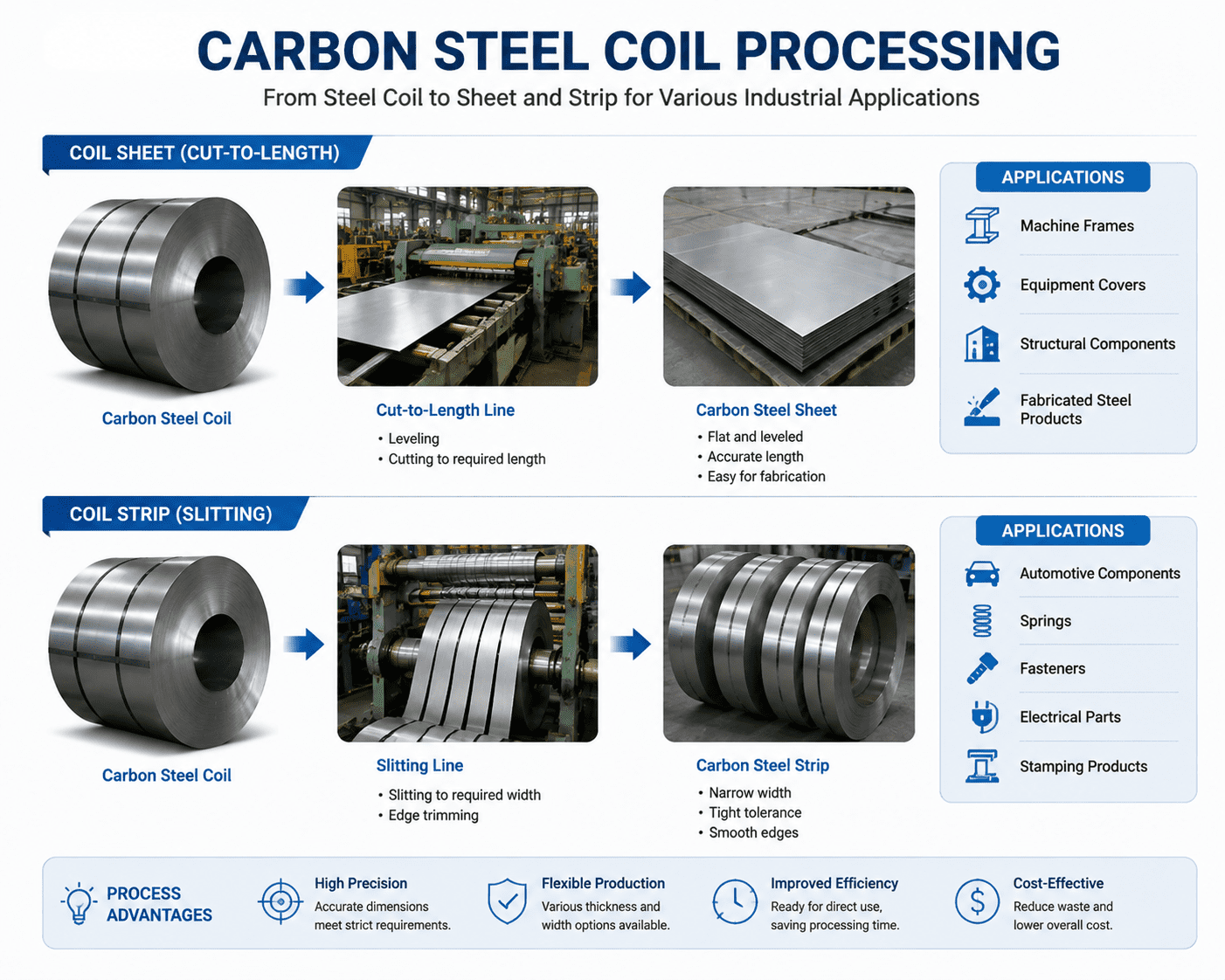
Although the basic product is carbon steel coil, customers often require different processing forms depending on their production methods.
Carbon Steel Coil Sheet
Carbon steel coil sheet is produced by cutting coils into flat sheets through a cut-to-length process.
It is commonly used by manufacturers that process steel with shearing, bending, welding, or fabrication equipment.
Applications include:
Machine frames
Equipment covers
Structural components
Fabricated steel products
The quality of coil sheets depends not only on the original coil but also on cutting accuracy, flatness control, and packaging during transportation.
Carbon Steel Coil Strip
Carbon steel coil strip is produced by slitting wide coils into narrower strips.
This product form is mainly used where precise width control is required.
Common applications include:
Automotive components
Springs
Fasteners
Electrical parts
Stamping products
For strip products, buyers usually pay attention to edge quality and width tolerance because small deviations may affect high-speed production lines.
How Carbon Steel Coils Are Manufactured
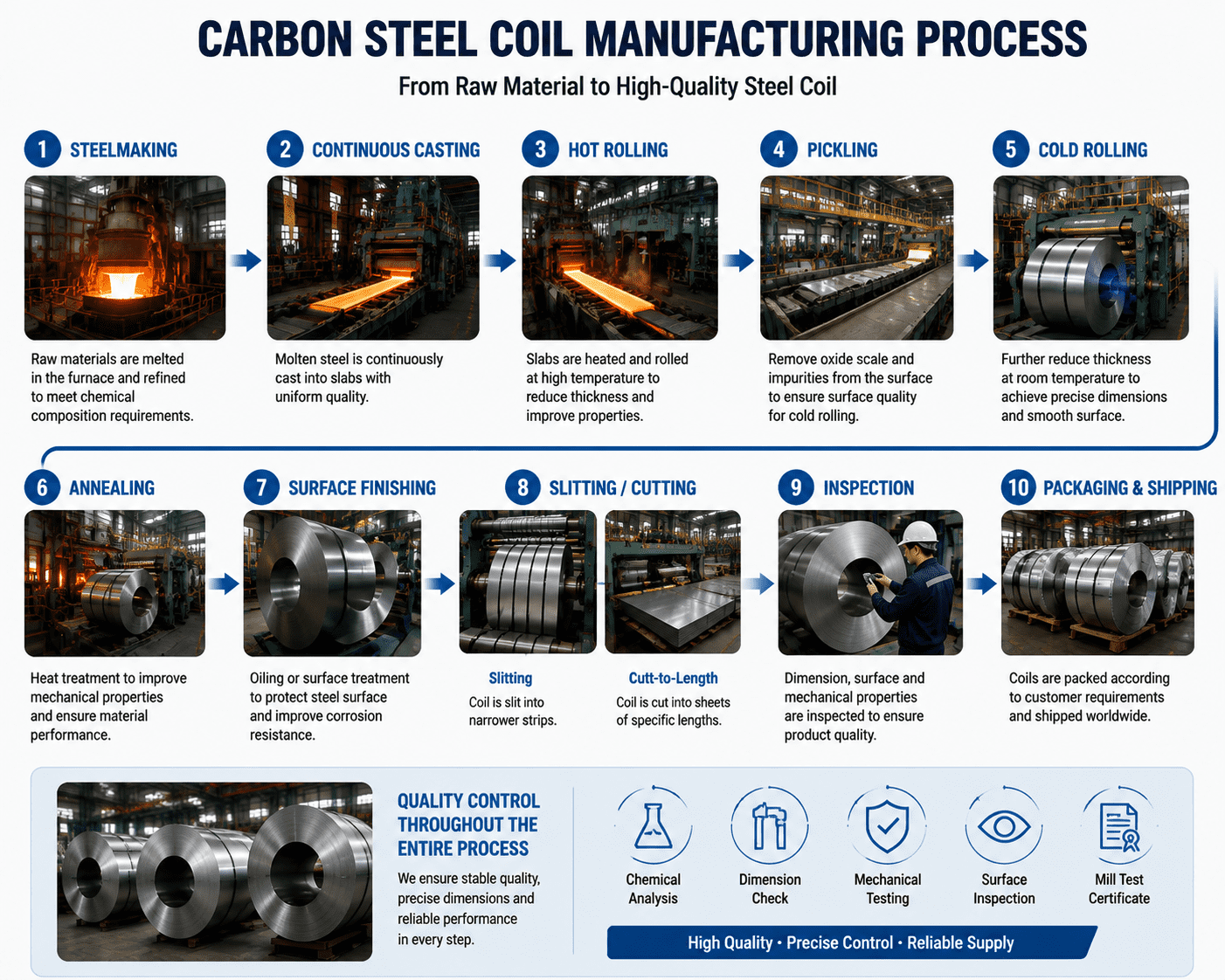
The manufacturing process of flat-rolled carbon steel coils involves several stages.
Steel production starts with melting raw materials and adjusting the chemical composition according to the required grade. After continuous casting, steel slabs are transferred to rolling mills.
For hot rolled production, slabs are heated and rolled into coils directly.
For cold rolled production, hot rolled coils normally go through:
Pickling to remove surface scale
Cold rolling to improve thickness accuracy
Annealing to adjust mechanical properties
Surface finishing according to customer requirements
Depending on customer needs, additional processing may include:
Slitting
Cut-to-length
Galvanizing
Oiling
Coating
A professional carbon steel coil Manufacturer normally controls each production stage to ensure stable quality between different batches.
Common Standards and Grades of Carbon Steel Coil
Different markets usually follow different steel standards.
Common international standards include:
ASTM (United States)
EN (European standards)
JIS (Japanese standards)
GB/T (Chinese standards)
Examples:
When purchasing from overseas suppliers, buyers should confirm not only the grade name but also the equivalent standard, because similar grades may have differences in chemical composition and mechanical requirements.
What Buyers Should Check Before Ordering Carbon Steel Coil
Based on actual steel trading experience, many purchasing problems happen because specifications are not confirmed clearly before production.
Before placing an order, buyers should confirm:
Material Specification
Including:
Grade
Standard
Thickness
Width
Coil weight
Surface Requirements
Different customers may require:
Black surface
Pickled and oiled surface
Smooth cold rolled surface
Coated surface
Quality Documents
A reliable supplier should provide:
Mill Test Certificate (MTC)
Chemical composition report
Mechanical test results
Dimension inspection report
For large projects, some buyers also request third-party inspection before shipment.
How to Select a Reliable Carbon Steel Coil Supplier
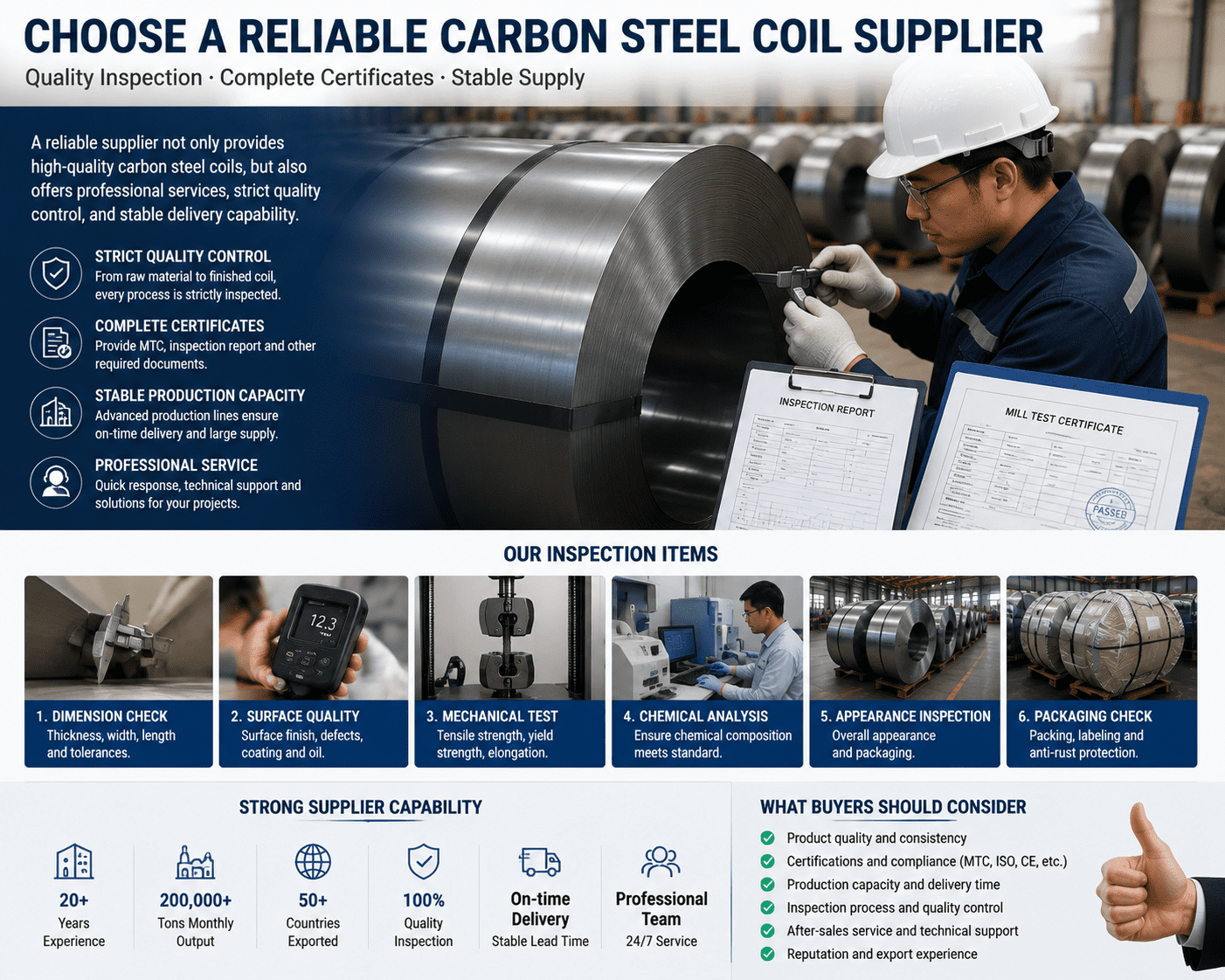
Finding a suitable carbon steel coil supplier is not only about comparing quotations.
A professional supplier should have:
Stable Production Capability
The supplier should be able to maintain consistent quality for repeated orders.
Export Experience
International steel supply involves documentation, loading requirements, and shipping arrangements. Experience in export operations helps reduce unnecessary delays.
Technical Understanding
A good supplier should help customers select suitable materials instead of simply recommending the cheapest option.
For example, a customer producing automotive parts may need cold rolled material with strict tolerance, while a construction company may prioritize strength and cost efficiency.
A reliable carbon steel coil Manufacturer should provide both products and technical support throughout the purchasing process.
Applications of Carbon Steel Coils in Different Industries
Carbon steel coils continue to be widely used because they can be processed into many different products.
In construction, hot rolled carbon steel coil is commonly used for structural components and fabricated steel structures.
In automotive manufacturing, cold rolled carbon steel coil is preferred for parts requiring good forming ability and surface quality.
In machinery production, carbon steel coils provide the strength required for equipment frames and industrial components.
In pipe manufacturing, coils are used as the starting material for welded pipes used in construction, energy, and transportation systems.
Carbon steel coil is not simply a rolled steel product. The correct choice depends on the relationship between steel grade, production process, application requirements, and supplier capability.
For buyers sourcing carbon steel coils, understanding the difference between hot rolled carbon steel coil, cold rolled carbon steel coil, carbon steel coil sheet, and carbon steel coil strip can help improve purchasing decisions.
A professional carbon steel coil Manufacturer or experienced carbon steel coil supplier should provide consistent material quality, accurate documentation, and practical support based on real manufacturing requirements.
In the steel business, reliable supply is built not only through competitive pricing, but also through technical knowledge, communication, and long-term cooperation.
Latest News
Hot rolled coil slitting enhances efficiency through automated uncoilers and rewinders. Key methods include precision tension control, edge guidance systems, and IoT integration. These optimizations reduce downtime, improve material yield, and ensure high-quality slit coils for automotive and machinery industries.
2025-09-19
Cold rolled coil is essential in home appliance manufacturing. It expertly combines thin gauge for lightweight, energy-efficient designs with high strength from optimized steel processing. This balance enables durable, high-performance appliances like refrigerators and washing machines, supporting industry trends towards sustainability and advanced production.
2025-09-17
Aluzinc coil offers exceptional corrosion resistance and weathering properties, making it ideal for photovoltaic mounting systems. Wholesale prices depend on material composition and market factors. Its applications in solar projects ensure durability and cost savings. Procurement should focus on certified suppliers and tailored specifications for optimal performance.
2025-09-11
The article discusses the selection and application of spring steel plates, like 65Mn, for automotive lightweighting. It covers heat treatment processes and key procurement considerations, emphasizing performance and durability in vehicle systems.
2025-09-08
The slitting process significantly impacts stainless steel strip material utilization. Optimizing techniques like precision cutting and smart layout planning boosts efficiency, reduces waste, and lowers production costs.
2025-09-05
Cost-Benefit Analysis of Aluzinc-Coated Steel vs. Galvanized Steel in Color Steel Tile Production
Aluzinc-coated steel offers superior corrosion resistance and longer service life than traditional galvanized steel, reducing long-term costs in color steel tile production. Despite higher initial prices, its durability and lower maintenance make it a cost-effective alternative. Manufacturers should evaluate environmental needs and lifecycle costs to choose between materials, ensuring optimal performance and competitiveness.
2025-09-03
CONTACT US
No. 58 Shuangjiang Road, beichen District, Tianjin,China
GET A FREE QUOTE